Industries / Education

Software for Education

Education is our deepest industry: a full ERP for institutions, an AI-powered LMS, and admission-to-alumni workflows — all working platforms we can demo on a call.

Book a free consultation
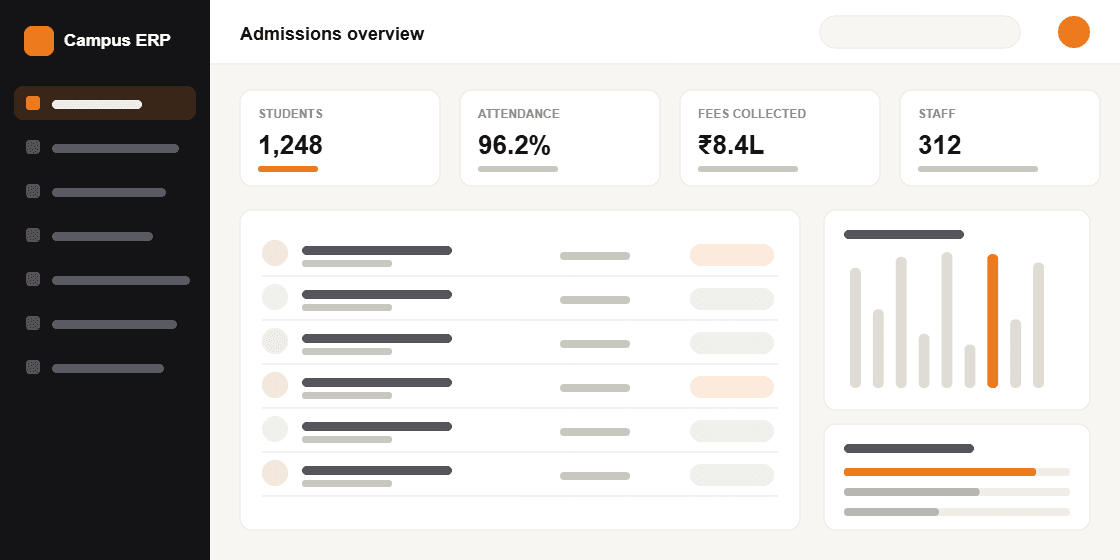
Education solution interface

{ 01 } — How we work in Education

Admission to alumni, one system.

Institutions run on interconnected workflows — admissions feed academics feed fees. We build them as one platform, not islands.

01

Map the institution

  • Academic structure
  • Admission funnels
  • Fee & compliance rules
02

Deploy

  • ERP module rollout
  • LMS & classrooms
  • Parent & student portals
03

Elevate

  • AI evaluation & tutoring
  • Analytics per batch
  • Certificates & records

{ 02 } — Why Digipix

The proof is a working product.

Book a platform walkthrough

Most vendors show slides; we show a running education ERP and an AI-powered LMS on a live call — admissions, fees, attendance, live classes, and AI evaluation included.

Engagements start from those platforms and shape them to your institution — months faster than building from zero.

Education is also where the gap between a demo and a deployment is widest. An admissions module that works in July has to survive the week in which four thousand applications arrive at once, and a fee module is judged on the one case in a hundred where a sibling concession meets a mid-session transfer.

{ 03 } — What we build

What we build for education.

Institution ERP

Admissions, academics, fees, attendance, exams, and administration.

Learning platforms

Courses, live classes, assignments, and AI-assisted evaluation.

Parent & student apps

Progress, fees, and communication in one place.

Coaching-center systems

Batches, tests, results, and counselor CRM for the coaching market.

{ 04 } — What makes it hard

Education software fails in predictable places.

Nearly every stalled institutional rollout we have been called into failed for one of these four reasons, and none of them appear on a feature comparison.

The academic calendar is not a calendar

Terms overlap, results are declared out of sequence, and a student can be enrolled in a course that ended and one that has not started. Systems that model the year as a straight line break in the first re-exam cycle.

Fees are a rules engine, not a price list

Sibling concessions, staff wards, scholarships, transport slabs, instalments, late fees, and mid-session route changes interact. The product that models fees as an amount per class is the one that gets abandoned in year two.

Teachers vote with their time

If marking attendance takes ninety seconds instead of fifteen, it gets batched on Friday and the data becomes fiction. Adoption is decided by the slowest routine task, not the best feature.

Parents are users, not recipients

A parent portal that is hard to use pushes traffic straight back to the front office, and the office falls back to the register. The parent app is where an institution's data quality is actually decided.

{ 05 } — What you have to get right

Boards and regulators do not accept a configurable report.

Affiliating bodies specify formats, not fields. CBSE, a state board, a university, UGC and AICTE each want records in a shape they defined, and a report builder that could theoretically produce it is not the same as a system that already does. This is the requirement most product evaluations discover after signing.

Student data also carries obligations beyond the academic ones. Records belong largely to children, which raises the bar under India's Digital Personal Data Protection Act on consent, retention, and access — including the question of what happens to a student's data in the years after they leave.

  • Board and university report formats produced as issued, not approximated
  • Academic Bank of Credits and DigiLocker identifiers carried on the student record from day one
  • Retention and deletion rules for alumni data, decided deliberately rather than by default
  • Role-based access that distinguishes a class teacher from an examination controller
  • An audit trail on marks and fee entries, because both get disputed

Related sectors

Get expert guidance on your education product.

Book a free consultation call — a senior team member replies within one business day with real thoughts, not a sales script.

Your idea stays yours — NDA on request
Honest scope and timeline, before any commitment

We reply within one business day.

We use these details only to respond to your enquiry. See our privacy policy.

Frequently asked questions

Yes — the education ERP and LMS are full working products, not mockups, and we will walk you through them on a consultation call.

Report formats, fee structures, and academic calendars are configured to your board or university conventions.

AI grades against rubrics with confidence thresholds — anything uncertain routes to the teacher, always.

Yes, and the modelling matters more than the feature. A group needs consolidated reporting with genuinely separate fee heads, admission numbering, and staff permissions per campus — not one database with a campus column, which is where products priced per campus usually stop.

It gets profiled before a date is committed to. Duplicate student records, fee heads that changed meaning between sessions, and marks stored in three formats are normal, and they set the timeline. We migrate at the session boundary and keep the old system readable for a full cycle.

{ Sources }

Standards and regulators referenced here

Let’s build for education.

Book a free consultation