Industries / Finance

Software for Finance

Money software has one rule: every rupee accounted for, every day. We build lending, collections, and reconciliation systems on that rule.

Book a free consultation
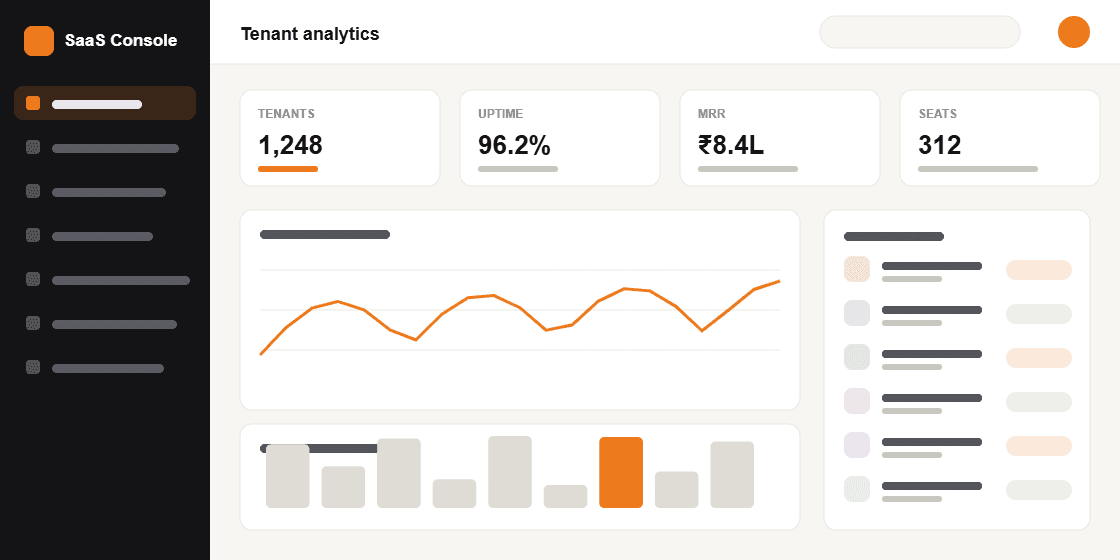
Finance solution interface

{ 01 } — How we work in Finance

Correctness first. Always.

Financial systems earn trust through boring rigor — immutable ledgers, daily reconciliation, and audit trails by default.

01

Model the money

  • Ledger & flow design
  • Compliance requirements
  • Control points
02

Build

  • Lending / collection workflows
  • Payment integrations
  • Immutable audit trails
03

Prove

  • Daily reconciliation
  • Regulator-ready reports
  • Exception queues

{ 02 } — Why Digipix

Built like the auditor is watching.

Discuss your finance product

A rounding error in finance is an incident, not a bug. Idempotent money movement and double-entry discipline are non-negotiable in everything we ship here.

We are the engineering side — we design controls and prepare evidence, working alongside your compliance advisors.

In practice that means the ledger is the product. Screens, apps, and dashboards are replaceable; a ledger that cannot explain how a balance came to be is not fixable later, because the explanation was never recorded. Everything else in a finance build is downstream of getting that one decision right on day one.

{ 03 } — What we build

What we build for finance.

Lending platforms

Origination, disbursal, EMI schedules, and collections tracking.

Collections & recovery

Buckets, follow-up workflows, and field-agent apps.

Reconciliation systems

Gateway, bank, and ledger matched daily — automatically.

NBFC & fintech dashboards

Portfolio, risk, and compliance reporting in one place.

{ 04 } — What makes it hard

Money systems fail quietly, then all at once.

A bug in a finance system rarely announces itself. It accumulates as a discrepancy nobody can explain, and these four are where it starts.

The network is the failure mode

A payment request that times out may have succeeded. Without idempotency keys and a reconciliation pass, the retry becomes a double debit — and the customer finds it before the monitoring does.

Rounding is a policy decision

Interest, penalties, part-payments, and taxes each round somewhere, and the choice compounds across a portfolio. It has to be decided explicitly and tested against known-good cases, not inherited from whichever numeric type the ORM defaulted to.

Dates carry more logic than amounts

Value dates, holidays, month-ends, leap years, and the interaction between a moratorium and an EMI schedule produce most of the defects we are called in to find. They are also the cases test suites skip.

History cannot be edited

Correcting a wrong entry by updating a row destroys the evidence that the correction happened. Reversals and adjusting entries are slower to build and are the only version that survives an audit.

{ 05 } — What you have to get right

Regulators ask for evidence, not assurances.

Which regulator applies depends on what you are — the RBI for lending and payments, SEBI for anything touching securities, IRDAI for insurance-linked products — and the technical obligations differ accordingly. What is common to all of them is that compliance is demonstrated with records, so the system has to produce them as a matter of course rather than on request.

Payment data adds its own layer. Card data brings PCI DSS into scope, which is most cheaply satisfied by never storing it — tokenise through the gateway and keep the sensitive fields outside your perimeter entirely. NPCI's rules govern how UPI flows are presented and handled, and they are specific about things product teams treat as UI choices.

  • Immutable, append-only transaction records with reversals rather than edits
  • Daily automated reconciliation across gateway, bank, and ledger, with an exception queue someone owns
  • Card data tokenised and never at rest in your systems
  • Data localisation for payment data, decided at the hosting layer rather than assumed
  • Regulator-ready reports generated from the ledger, not assembled in a spreadsheet
  • Access control and maker-checker on anything that moves money

Get expert guidance on your finance product.

Book a free consultation call — a senior team member replies within one business day with real thoughts, not a sales script.

Your idea stays yours — NDA on request
Honest scope and timeline, before any commitment

We reply within one business day.

We use these details only to respond to your enquiry. See our privacy policy.

Frequently asked questions

No — we build the technical controls and evidence; your legal and compliance advisors own the regulatory interpretation. We work well alongside them.

Yes — payment gateways, payout APIs, and account-aggregator style integrations with the retry and reconciliation discipline they demand.

Golden-case suites on every money path, run on every change — interest, penalties, and edge dates included.

The request carries an idempotency key, so a retry cannot create a second debit, and the transaction sits in a pending state until the gateway is queried for its true status. Nothing is marked settled on the strength of a response we did not receive.

Yes. Most engagements here are integration rather than replacement — building the layer your core system does not have, with a defined contract between the two and reconciliation proving they agree. Replacing a core is a different project and should be a deliberate one.

{ Sources }

Standards and regulators referenced here

Let’s build for finance.

Book a free consultation